Digitisation Is Not Automation: Why a Project Clears Acceptance and Delivers No Effect
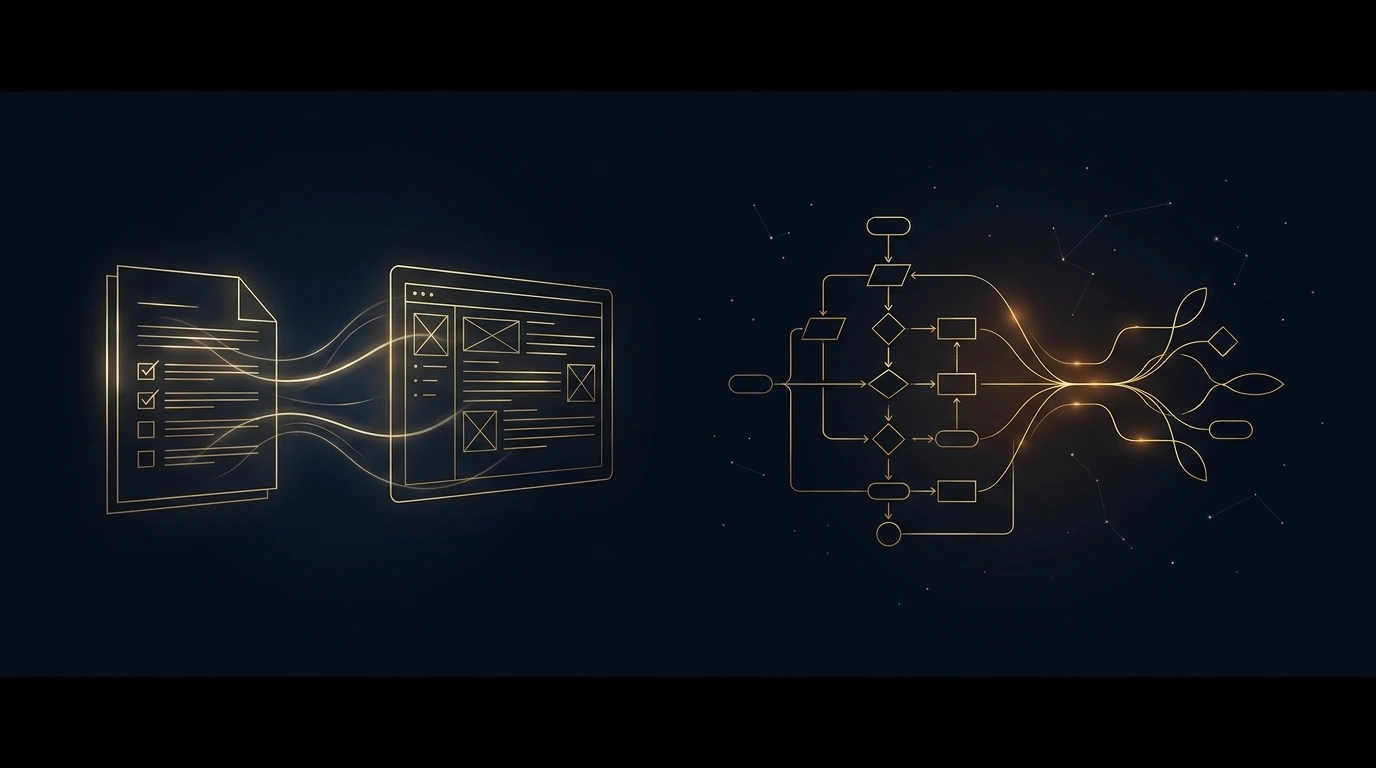
There's a reliable tell for a project that will clear acceptance and deliver no effect. The results report doesn't mention a single rule that changed: it lists the modules deployed, the users trained, the data migrated, and the share of processes "covered by the system." Not one line about what's now done differently.
A project like this isn't deceiving anyone on purpose. It's reporting exactly what happened: the work moved from paper and spreadsheets into an interface. The trouble is that the move, on its own, changes neither the effort required nor the error rate — it only changes where they show up.
Digitisation moves work into a digital environment; automation removes the work altogether. One question separates them: which rule changed. If the answer is none, the effect will be zero or negative — healthcare measurements show that moving to electronic systems without reengineering the underlying process raises the share of administrative time instead of cutting it.
Four Signs Digitisation Is Passing Itself Off as Automation
All four signs are visible at the acceptance stage, and none of them require special expertise. It's enough to read the project report and put four questions to it — a finance director or an operations lead can do this in twenty minutes, without opening a single system screen.
The report is written entirely in nouns. Deployed, configured, trained, migrated. Automation, by contrast, gets described in verbs of disappearance: "the calculation is no longer done by hand," "approval is no longer required," "the field no longer needs to be filled in." If wording like that is missing from the report, the underlying work hasn't gone anywhere — it has only changed its address.
The number of process steps hasn't changed. There were nine steps before the project; there are still nine after it, just carried out inside the new system instead of on paper. This is the single most reliable sign, because real automation always cuts the number of steps — a step disappears when its output starts being computed by a rule rather than performed by a person.
New mandatory actions have appeared. Mark a status, tick a flag, duplicate an entry into an adjacent system. Every one of these actions is new work that didn't exist before the project, and in practice it usually lands on the very person whose workload the project was supposed to reduce — the case handler, the account manager, the clerk closing out the file.
The effect is measured by coverage. "Eighty percent of requests are now processed in the system" is a rollout metric, not a results metric. It climbs under every scenario, including the one where handling time for a single request has doubled and nobody noticed, because nobody was tracking handling time to begin with.
| Sign | What it means | Question to ask |
|---|---|---|
| The report is written entirely in nouns | No rules changed | What is now done differently? |
| Number of steps is unchanged | Work moved, it didn't disappear | Which step stopped existing? |
| New mandatory actions appeared | Work was added, not removed | Who performs them, and what do they get back in exchange? |
| Effect is measured by coverage | The actual result was never measured | How long does one case take now? |
It's usually the last question that exposes the problem. There was no time measurement taken before the rollout, so there's nothing to answer with, and the conversation quietly retreats back to coverage numbers.
A Distinction Defined Thirty-Five Years Ago
The topic isn't new, and its sharpest formulation predates today's enterprise software by decades — long before anyone was pitching a platform, a portal, or an AI copilot.
In the case the author walks through, a company had planned to automate its supplier payment process and cut the department's headcount by 20%. After the process itself was reengineered — the number of line items reconciled at payment time dropped from 14 to 3, and matching against the supplier invoice was eliminated altogether — the actual reduction came to 75%.
The limitation is real, and I'll state it myself: this is a management article built on case studies, not a peer-reviewed study, and the figures were never independently audited. The value lies elsewhere — in the precision of the distinction it draws. The gap between a 20% reduction and a 75% reduction didn't come from a better computer system. It came from a decision to check three line items instead of fourteen. That's a process decision, and a company could have made it with a pencil and a policy memo, no software required.
What Healthcare Data Actually Shows
Healthcare is one of the rare fields where the shift to electronic systems has been measured not through surveys but through event logs and direct time-and-motion tracking, across large samples and over multiple years. The conclusions travel well to any industry where a written record is mandatory — insurance, banking, logistics, professional services.
Physicians spent 355 minutes (5.9 hours) inside the electronic health record system over an 11.4-hour workday, of which 157 minutes — 44.2% of their time in the system — went to clerical and administrative tasks rather than patient care.
One specialty, one academic health system, one software vendor — generalizing straight across to other industries calls for caution. But the method here is strong: not self-report, but event logs cross-checked against direct timing. This is precisely the kind of measurement that's missing from corporate implementation projects, where the effect is evaluated by coverage instead.
An even more convincing result comes from a study that directly compared the paper and electronic version of the same job.
Resident physicians spent 73.0% of their time on tasks unrelated to the patient and only 17.9% on direct patient care. Among electronic health record users, the share of administrative time was higher than among colleagues still working on paper: 44.1% versus 37.3%.
Time allocation here was captured through participants' own reports rather than system logs — a real limitation — and the sample is confined to junior medical staff in one country. Even so, the direction of the finding runs directly opposite to what digitization is supposed to deliver: administrative time is higher for electronic-record users, not lower. The electronic form didn't remove a single requirement. It simply made meeting all of them more labor-intensive.
Why It Gets Worse Over Time, Not Better
The second counterintuitive fact: the workload inside a digital system running on unchanged rules keeps climbing over time, and it doesn't level off on its own.
Over four years, a physician's total time in the electronic system per eight-hour clinic day rose by 28.4 minutes (+7.8%): time spent placing orders increased by 58.9%, and time spent processing inbox messages increased by 24.4%.
The period partly overlaps with post-pandemic workload recovery, which could inflate the trend somewhat — that caveat has to be stated plainly. But the underlying mechanism is easy to follow and reproduces itself everywhere: in a system that never eliminates a requirement, every new requirement simply stacks on top of the ones already there. Rules accumulate for a mundane reason — adding a field to a form is cheaper, and far less politically fraught, than removing one.
How to Tell the Difference Before You Start
The second step needs someone with the authority to eliminate a step, and that's the real organizational obstacle, not a technical one. A vendor doesn't hold that authority. IT usually doesn't hold it either. Until the process owner has made the call to eliminate a step, any project defaults to a move by design — the same point I make in a companion piece on why you fix the process before you implement the system.
Four Questions for Every Implementation Report
Which step stopped existing
Not "got faster" — actually gone. If there isn't one, any effect you see will come only from the move itself.
Which rule changed
How many line items get reconciled, who signs off, what no longer needs to be filled in. A rule is something that used to be mandatory and now isn't.
How many new actions appeared
Status flags, markers, duplication into adjacent systems. Their total gets subtracted from whatever effect the project claims.
How long does one case take now
Minutes per outcome, measured before and after. Interface coverage is not an answer to this question, no matter how it's phrased.
If the implementation results report doesn't list a single eliminated step, you paid to relocate the work — not to shrink it.
Frequently Asked Questions
What's the actual difference between digitisation and automation?
Digitisation moves work into a digital environment while keeping its volume the same: the same steps, the same approvals, the same fields to fill in — just on screen instead of on paper. Automation removes work: a step stops being performed because its outcome is now computed by a rule or is no longer required at all. There's exactly one test that separates the two — did the number of process steps change.
Can digitisation be worthwhile on its own, without automation?
Yes, but for different reasons than the ones usually pitched: the data becomes available for analysis, the work stops depending on where a particular person happens to be sitting, and a change history appears where none existed before. Those are real, legitimate benefits, and they're worth naming plainly as what they are. The mistake happens when digitisation gets sold as a reduction in effort — a year later, someone has to explain to the budget owner why the clerical burden never actually changed.
Why does the workload grow after a new system goes live, rather than shrink?
Because a digital form makes it possible to add requirements that would have been unworkable on paper: extra mandatory fields, status flags, duplication into adjacent systems for reporting purposes. None of the old requirements get removed in the process — removing a requirement is more expensive and far more politically difficult than adding a new one. That's how the load accumulates quietly, and the healthcare measurements above show that accumulation happening in real time, year over year.
Who should be the one to decide that a step gets eliminated?
The process owner — the person who is accountable for its outcome, not the person who happens to be running the project. Neither the vendor nor the IT department holds that authority, and neither of them should: eliminating a step means accepting a risk, and the risk has to sit with whoever is answerable for the result. If a project has no one on it who can actually say "we no longer perform this check," the project will default to a move, regardless of how the statement of work is worded.
The list of four warning signs and the sequence of questions for an implementation report are the author's own synthesis, drawn from CRM and in-house product rollouts at Alego.Digital and from acceptance practice under the company's client-engagement procedure. No internal metrics are quoted in this article — every figure cited above comes from an external source with its method stated. There's no formalized write-up of this particular check in the company's own documents.
- Hammer M. Reengineering Work: Don't Automate, Obliterate. Harvard Business Review, July–August 1990. hbr.org
- Arndt B. G. et al. Tethered to the EHR: Primary Care Physician Workload Assessment. Annals of Family Medicine, September 2017. annfammed.org
- Arab S. et al. Time Allocation in Clinical Training (TACT). QJM: An International Journal of Medicine, October 2025. academic.oup.com
- Arndt B. G., Micek M. A., Rule A. et al. Longitudinal Analysis of EHR Use, 2019–2023. Annals of Family Medicine, January 2024. annfammed.org